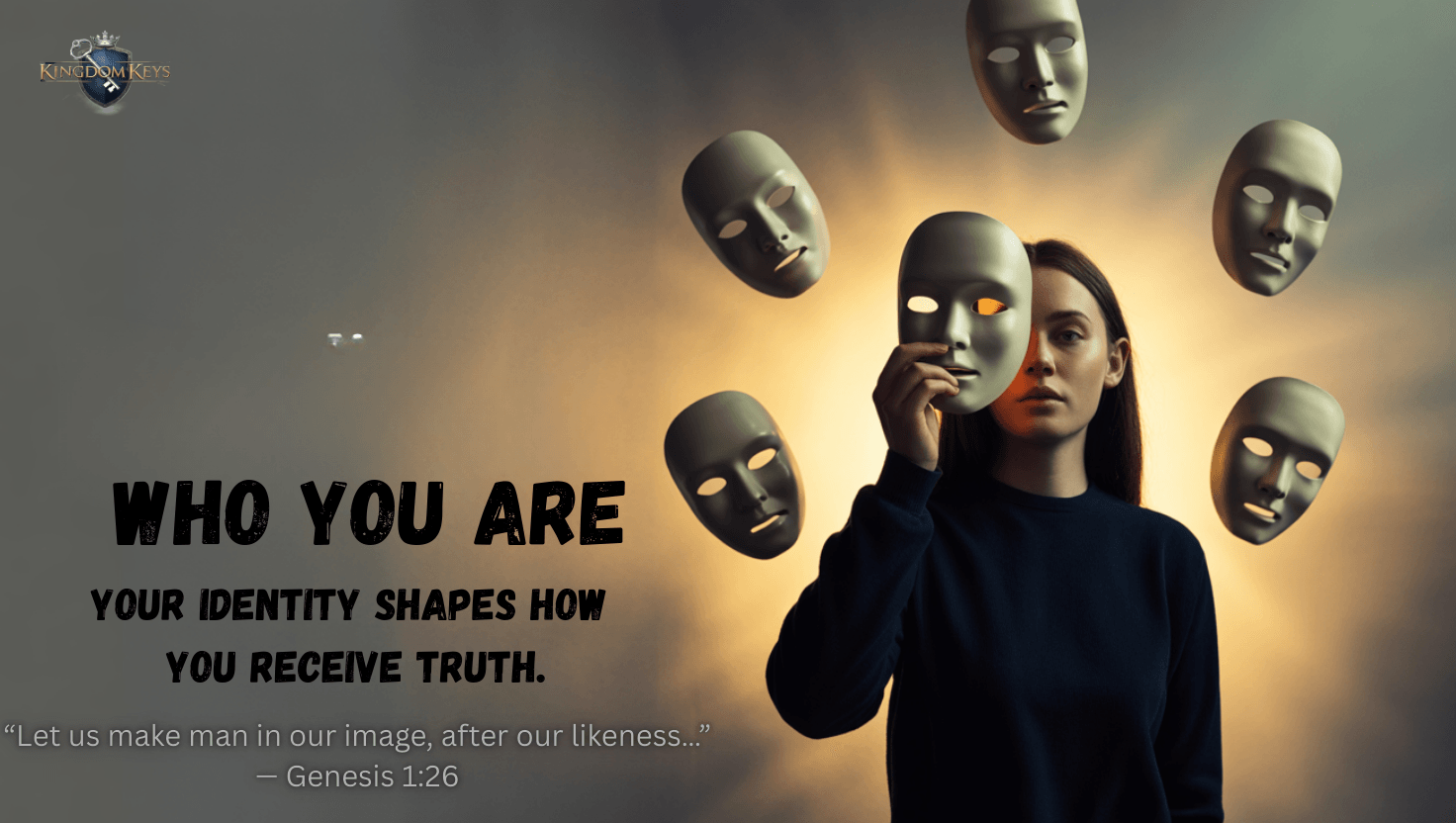
Who You Are?
Identity Before Interpretation
Before you interpret scripture… Before you try to understand truth… You are already seeing through a lens.
That lens is shaped by who you believe you are.
And until identity is brought into clarity, interpretation will always be influenced by distortion.
📖 “As he thinks in his heart, so is he.” — Proverbs 23:7
Before most people ever open a Bible… Before they begin searching for truth… Something has already been formed within them:
A sense of who they are.
This identity is often not questioned. It feels natural. Familiar. Even “true.”
But in many cases, it has been shaped over time by:
- Family and upbringing
- Life experiences—both positive and painful
- Words spoken by others
- Cultural and religious teaching
- Personal successes and failures
Without realizing it, many people come to scripture—and to life itself—not to discover truth… But to confirm the identity they already carry.
Two people can read the same scripture:
“One sees a loving Father.” “The other sees a distant authority.”
The words didn’t change.
The identity behind the reader did.
A person who believes: “I’m not good enough…”
May read correction in scripture as rejection.
But a person who understands: “I am loved and being refined…”
Will read the same correction as guidance. The difference is not in the text.
The difference is in the lens.
A Gentle Truth to Consider:
If identity is unclear…
Then interpretation will often be unstable.
And if interpretation is unstable… It becomes difficult to walk in clarity, confidence, and peace.
This page is not about tearing down who you are.
It is about gently stepping back… And asking: “Is the identity I’m living from actually true?”
Take your time with this.
There is no pressure here.
Only an invitation to see more clearly.
What Is Identity (and Where It Comes From)
At its core, identity answers a very simple question: “Who am I?”
But for most people, the answer to that question didn’t come from deep reflection… It was formed over time—often without conscious awareness.
How Identity Is Formed:
From a very early age, identity begins to take shape through repeated experiences and messages. A child may not say, “This is shaping my identity…” But internally, something is being established.
For example: “I am capable. I am valued.”
- A child who is constantly affirmed may begin to believe,
“I’m not enough. I always get it wrong.”
- A child who is often criticized may begin to believe,
“I have to be careful… I can’t make mistakes.”
- Someone who grows up in a strict or fear-based environment may begin to believe,
These beliefs don’t stay as simple thoughts. Over time… They become identity.
Identity Is Not Just What You Think—It’s What You Live From:
Many people assume identity is just what they say about themselves. But identity goes deeper than words.
It shows up in:
- How you respond to challenges
- How you receive correction
- How you handle success or failure
- What you expect from life
- How you believe God sees you
Two people make a mistake.
One thinks: “I messed up… but I can learn from this.”
The other thinks: “This proves I’m a failure.”
Same situation.
Different identity.
Where Most Identity Comes From:
Without realizing it, many people build their identity from:
- Past experiences
- Emotional wounds
- Labels given by others
- Roles they’ve played (parent, employee, provider, etc.)
- Religious interpretations they’ve heard repeated
And while some of these influences may carry truth… Many of them are incomplete or distorted.
Why This Matters:
If identity is formed unconsciously… Then it is often accepted without being examined.
And if it is not examined…
It quietly begins to shape:
- What you believe is possible
- What you believe you deserve
- How you interpret God, scripture, and life
A Grounding Truth:
Not everything you have believed about yourself… Was intentionally chosen. Much of it was absorbed.
And that means something very important: If identity was formed… It can also be examined.
Not with pressure. Not with judgment.
But with awareness.
This is where clarity begins.
How Identity Shapes Interpretation
Once identity is formed… It doesn’t just sit quietly in the background.
It begins to interpret everything.
Every situation… Every conversation…
Every scripture… Is filtered through the lens of: “Who I believe I am.”
You Don’t Just See—You Interpret:
Most people believe they are simply seeing things “as they are.”
But in reality… We are often seeing things as we are.
An Everyday Example:
Someone doesn’t return your call.
One person thinks: “They must be busy. I’ll catch up with them later.”
Another thinks: “I must have done something wrong… maybe they’re avoiding me.”
Different interpretation.
The difference isn’t in what happened.
It’s in the identity behind the interpretation.
How This Shows Up in Scripture:
This becomes even more important when approaching scripture.
A person who sees themselves as:
- Unworthy
- Constantly failing
- Never quite measuring up
May read scripture and mainly notice:
- Judgment
- Correction
- Fear of getting it wrong
But someone who understands themselves as:
- Loved
- Growing
- Being guided and refined
Will read the same scripture and see:
- Instruction
- Wisdom
- Invitation to grow
Same words. Different experience.
Another Real-Life Example:
Imagine two people hearing this statement:
“You need to make a change.”
One hears: “I’m not good enough.”
The other hears: “There’s an opportunity for growth.”
The words are identical.
But identity determines whether the message feels like: Rejection… or direction.
Why This Matters So Much:
If identity is not clear… Then interpretation becomes unstable.
And when interpretation is unstable:
- Truth can feel confusing
- Growth can feel threatening
- Guidance can feel like pressure
- Correction can feel like condemnation
A Gentle but Powerful Realization:
Many people are not struggling with truth itself… They are struggling with the lens they are using to see it.
And until that lens is recognized… Even clear truth can feel unclear.
A Grounding Insight:
You are not just reading scripture.
You are reading it from somewhere.
And that “somewhere”… Is your current sense of identity.
This is why identity must come first.
Not to complicate things… But to bring clarity to everything that follows.
False Identity vs True Identity
As identity begins to come into focus…
A natural question arises: “Is everything I believe about myself actually true?”
This is where a gentle distinction becomes important:
There is a difference between:
What was formed… And what is true.
What Is a False Identity?:
A false identity is not something you intentionally chose.
It is something that was built over time through:
- Repeated experiences
- Emotional moments
- Words spoken by others
- Situations that left an impression
Over time, these experiences can form beliefs like:
- “I’m not enough”
- “I always mess things up”
- “I have to prove myself to be accepted”
- “I’m only valued when I perform well”
These beliefs can feel very real.
But feeling real… Does not make them true.
Real-Life Example:
A child struggles in school and is told repeatedly:
“You’re just not that smart.”
Over time, that child may grow into an adult who believes:
“I’m not capable.”
Even if they later succeed…
That identity may still quietly influence how they see themselves. The identity was formed.
But it was not founded in truth.
What Is a True Identity? A true identity is not based on:
- Past mistakes
- Other people’s opinions
- Temporary seasons
- Emotional experiences
A true identity is stable.
It is not easily shaken by:
- Failure
- Success
- Approval
- Rejection
From a biblical foundation, true identity is rooted in understanding:
You are:
- Created with intention
- Known by God
- Capable of growth
- Designed with purpose
Not because of what you’ve done… But because of who you were created to be.
Another Everyday Example:
Someone receives criticism.
If they operate from a false identity, they may think: “This proves something is wrong with me.”
But from a true identity, they can recognize: “This is something I can learn from… without it defining me.”
The difference is not denial.
It is stability.
Why This Distinction Matters:
When false identity is mistaken for truth:
- Correction feels like rejection
- Growth feels like pressure
- Life feels like constant proving
But when identity is rooted in truth:
- Correction becomes guidance
- Growth becomes natural
- Life becomes a process—not a performance
A Gentle Realization:
You don’t have to fight who you are…
But you may need to gently question:
“Was this identity formed… or is it actually true?”
This is not about rejecting yourself. It is about removing what was never truly you to begin with.
You are not discovering a new identity. You are uncovering what has always been true…
Beneath what was formed. And that process begins with awareness.
Why Misidentification Leads to Misunderstanding
When identity is misunderstood… Everything built on top of it becomes unstable.
It’s not always obvious at first. Life can still function. Decisions still get made. Scripture is still read.
But underneath it all… There is often confusion, inconsistency, or inner tension.
Misidentification Changes Meaning:
When a person is operating from a false or unclear identity… They don’t just experience life differently.
They assign meaning differently.
A Simple Real-Life Example:
Someone doesn’t get selected for an opportunity.
One person thinks: “That just wasn’t the right fit. Something else will open.”
Another thinks: “This always happens to me. I’m just not good enough.”
Same event.
Different meaning.
And over time, those meanings begin to shape:
- Confidence
- Decisions
- Expectations
- Direction in life
How This Shows Up Spiritually:
Misidentification doesn’t just affect daily life…
It deeply affects how a person relates to God and scripture.
For example: If someone sees themselves as distant from God… They may interpret scripture as something they must strive to reach.
But if someone understands they are already known and seen… They approach scripture as something that reveals what is already available to them.
A person hears: “You need to grow in this area.”
From misidentification, they may hear: “I’m failing again.”
From clarity in identity, they hear: “This is an opportunity to develop.”
Same words.
Different understanding.
Why Misunderstanding Feels So Real:
Because the identity underneath it feels real.
If someone has believed for years: “I’m not enough…”
Then any situation that seems to confirm that belief will feel true—even if it isn’t. This is how misunderstanding becomes reinforced.
Not because truth is unclear… But because identity is influencing how truth is received.
The Hidden Cycle:
Misidentification creates a cycle:
Identity shapes interpretation
Interpretation shapes experience
Experience reinforces identity
And without awareness… That cycle continues automatically.
Many people are not struggling because truth is hidden.
They are struggling because: Their identity is quietly reshaping what truth looks like.
Breaking the Pattern:
The moment identity begins to be questioned… Understanding begins to shift.
Not because life suddenly changes… But because meaning becomes clearer.
And when meaning becomes clearer:
- Confusion begins to settle
- Fear begins to loosen
- Growth begins to feel possible
A Gentle Reminder: You are not “getting everything wrong.”
You may simply be seeing through a lens… That was never meant to define you.
And once that is recognized… Understanding begins to realign naturally.
Returning to a Truth-Based Identity
As we begin to recognize how identity has been formed… And how it has shaped interpretation…
A natural question arises:
“So how do I come back to what is true?”
The answer is not found in trying to become someone new.
It begins by returning to what has always been true—beneath what was formed.
This Is Not About Reinventing Yourself:
Many people approach growth as if they need to:
- Fix themselves
- Rebuild themselves
- Become someone completely different
But this often creates more pressure than clarity.
Returning to a truth-based identity is not about adding something new. It is about removing what was never truly you.
Imagine wearing a label for years that says: “Not enough.”
Over time, you begin to live from that label.
You hesitate. You second-guess. You hold back.
Returning to truth doesn’t require you to “become enough.”
It begins with recognizing: That label was never true to begin with.
What Returning Actually Looks Like:
Returning to a truth-based identity is a quiet process.
It often looks like:
- Noticing the thoughts you’ve always believed about yourself
- Gently questioning where they came from
- Choosing not to automatically agree with them
- Allowing space for something more true to emerge
It is less about striving… And more about becoming aware.
A Practical Everyday Example:
You make a mistake.
The old identity says: “See… this is who I am.”
But instead of agreeing with it, you pause and recognize:
“This is something I did… not who I am.” That small shift begins to change everything.
What Begins to Change:
As identity becomes clearer:
- You respond instead of react
- You grow without feeling condemned
- You receive guidance without feeling attacked
- You move forward without constantly proving yourself
Not because life becomes perfect… But because your foundation becomes stable.
Truth-based identity does not fluctuate with:
- Performance
- Opinions
- Temporary outcomes
It remains steady.
And from that place… Clarity in interpretation begins to follow naturally.
A Gentle Invitation:
You don’t have to force this process.
You don’t have to figure everything out at once.
You can simply begin by asking: “Is this belief about myself actually true?”
And allow that question… To create space for something deeper to surface.
A Final Insight for This Section:
The goal is not to become someone else.
The goal is to see clearly enough to stop misidentifying yourself.
And when identity becomes clear… Everything else begins to align.
A Simple Practice: Noticing Without Agreeing:
One of the most powerful ways to begin returning to a truth-based identity… Is to simply start noticing what you’ve been agreeing with.
Throughout your day, pay attention to moments when a thought about yourself arises:
- “I always mess things up…”
- “I’m not good at this…”
- “This is just who I am…”
Instead of immediately accepting the thought…
Pause. And gently ask:
“Is this actually true… or is this something I’ve learned to believe?”
You don’t have to fight the thought. You don’t have to replace it immediately.
Just don’t automatically agree with it.
Agreement is what gives identity its strength.
When something is repeated and believed over time… It begins to feel like truth.
But the moment you pause and question it… You create space. And in that space…
Clarity begins to form.
A Simple Shift in Real Time:
Old pattern: “I failed… this is who I am.”
New awareness: “I failed… but that doesn’t define who I am.”
That small separation… Is where identity begins to realign.
Keep It Simple: You don’t need to monitor every thought. You don’t need to do this perfectly.
Just begin noticing… A few moments each day.
That is enough to start.
A Grounding Reminder:
You are not trying to become someone else. You are simply learning to stop agreeing with what was never true.
And as that happens… What is true begins to surface naturally.
Reflection / Integration
Take a moment to pause.
There is no need to rush through this.
The goal here is not to “figure everything out”… But to begin noticing more clearly.
🪞 Reflective Questions:
You may want to read these slowly… Or even return to them later.
1. What are some beliefs I’ve carried about myself for a long time?
Without trying to change them… Simply notice what comes up.
2. Where did these beliefs come from?
Were they formed through: There is no need to overanalyze—just observe.
- Experiences?
- Words spoken by others?
- Repeated situations?
3. How have these beliefs shaped the way I see myself… and my life?
Consider: Let this be an honest reflection… not a judgment.
- How you respond to challenges
- How you receive correction
- What you expect from yourself
4. Have I been interpreting situations—or even scripture—through these beliefs?
Gently consider: Have certain patterns of thinking influenced how you understand things? There is no right or wrong answer here. Only awareness.
5. What might change if I no longer assumed these beliefs were true?
You don’t have to replace them. Just allow yourself to imagine:
“What if this isn’t who I am?”
🧭 How to Approach This Time:
Move through these questions slowly.
If something stands out, sit with it for a moment.
You don’t need to fix anything.
You don’t need to come to conclusions.
Just begin to notice.
Because awareness… Is where clarity begins.
A Gentle Encouragement:
If something feels uncomfortable or unfamiliar… That’s okay.
You are not losing yourself. You are simply beginning to see…
What may have been shaping you all along. And that awareness is a step toward freedom.
Closing Thoughts
Clarity does not come from rushing to define yourself… It comes from seeing clearly enough to stop misidentifying yourself.
You don’t have to rebuild who you are.
You don’t have to force a new identity into place.
You can simply begin… By becoming aware of what has been shaping how you see yourself.
And as that awareness grows… Something steady begins to emerge.
Not something new… But something that has always been there.
A Quiet Truth to Hold Onto:
You are not the labels you’ve carried.
You are not the conclusions formed in difficult moments.
You are not defined by past experiences.
Those things may have shaped how you’ve seen yourself… But they do not define who you are.
A More Stable Place to Stand:
- You begin to read scripture with greater peace
- You begin to approach life with less pressure
- You begin to grow without feeling like you’re constantly proving something
Not because everything changes around you… But because something becomes steady within you.
A Gentle Invitation Moving Forward:
You don’t need to have everything resolved.
You don’t need to fully understand your identity all at once.
You can simply continue:
- Noticing what you’ve been agreeing with
- Questioning what may not be true
- Allowing clarity to unfold over time
That is enough.
📖 “And we all… beholding as in a mirror the glory of the Lord, are being transformed into the same image from glory to glory…” — 2 Corinthians 3:18
This is not a forced transformation.
It is a gradual uncovering… through seeing clearly.
Final Thought:
Before interpretation…
Before understanding…
Before application…
There is identity.
You are not becoming someone else.
You are simply learning to see… Who you have been all along.