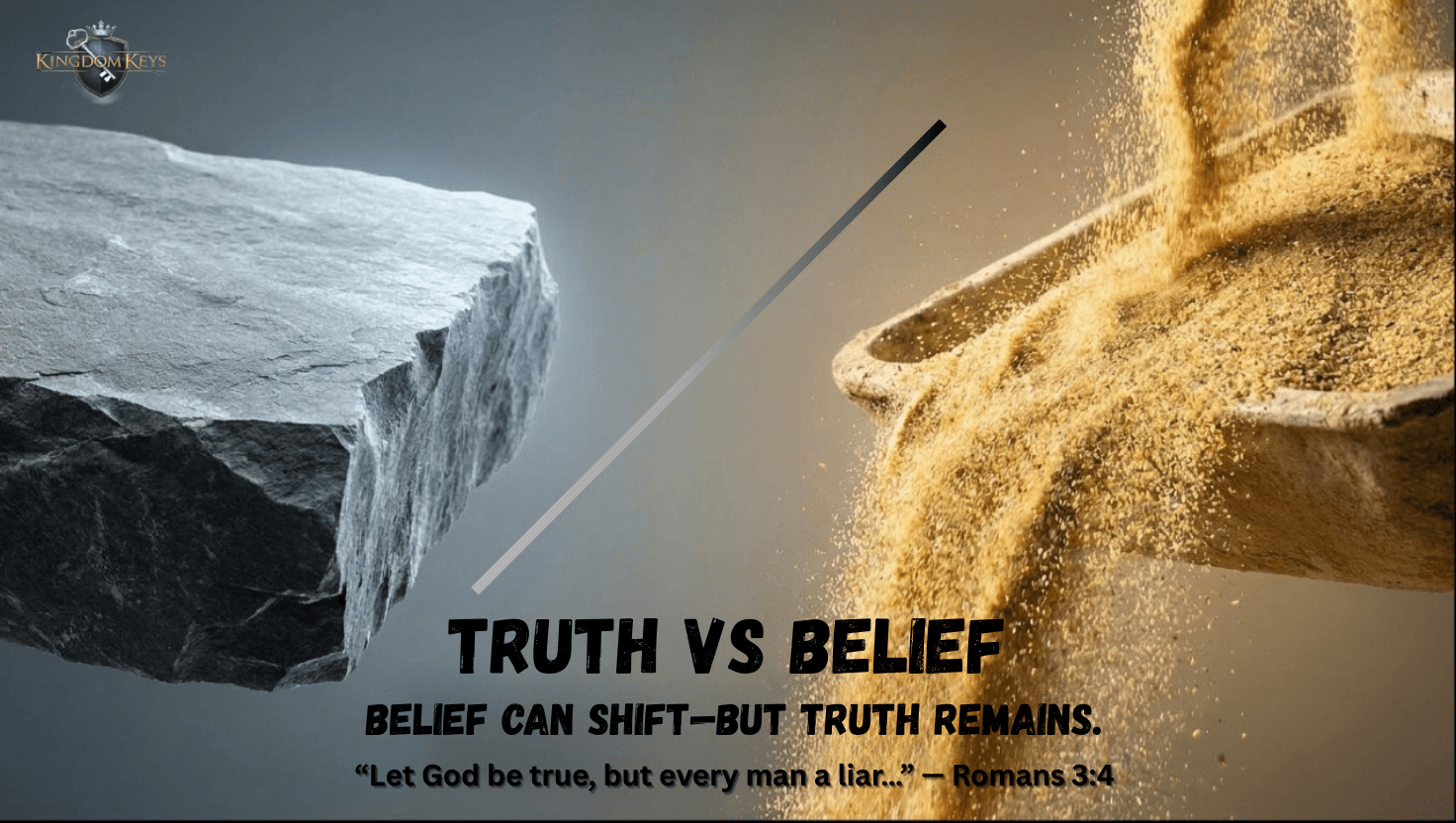
Truth vs Belief
What Remains Unchanging
Not everything we believe is truth.
Some beliefs are inherited. Some are taught. Some are formed through pain, experience, fear, or repetition.
But truth does not change when beliefs change. Truth remains steady, whole, and unshaken.
This page is an invitation to gently explore the difference — so you can build your life, your understanding, and your spiritual walk on what is real, not merely what has been accepted.
📖 "Sanctify them through thy truth: thy word is truth." — John 17:17
Truth Is Not the Same as Belief
Many people use the words truth and belief as if they mean the same thing.
But they are not the same.
A belief is something a person accepts as true.
A truth is what is true whether a person accepts it or not.
That distinction matters more than many realize.
A person can believe something for years and still be mistaken.
A family can pass down an idea for generations and still misunderstand it.
A culture can reinforce a perspective so often that it begins to feel unquestionable — and still not be standing on truth.
This is not said to create fear or confusion. It is said to create freedom.
Because when a person begins to understand that beliefs can be examined, they are no longer trapped by everything they were taught, everything they assumed, or everything they once accepted without question.
They can begin to ask with greater honesty:
Is this actually true — or have I simply believed it for a long time?
That question is not dangerous when approached with humility. It is often the beginning of deeper clarity.
Scripture repeatedly calls us not merely to repeat what we have heard, but to come into alignment with truth. That means we must sometimes allow what is false, incomplete, distorted, or immature within our thinking to be exposed — not to shame us, but to free us.
For example, a child may believe that thunder means someone is angry in the sky. That belief may feel true to them, but it does not make it truth.
In the same way, many adults live by ideas about God, themselves, other people, life, worthiness, punishment, love, lack, identity, or possibility that were formed early and never deeply examined. These beliefs may shape emotions, choices, and interpretations every day — even when they are no longer accurate, healthy, or aligned with divine truth.
Truth does not become truth because we believe it. And something false does not become true because many people agree with it.
Truth remains what it is.
This page is here to help seekers slow down and recognize that difference with greater peace and greater clarity. Not so they become argumentative, suspicious, or mentally restless — but so they can become more stable, more discerning, and more deeply rooted in what does not shift with opinion, emotion, tradition, or fear.
Because beliefs may change.
But truth remains unchanging.
What Is Truth vs What Is Belief
Understanding the Difference Clearly
To move forward with clarity, it helps to define these two words in a simple and grounded way.
A belief is something you accept as true.
A truth is what is true — whether you accept it or not.
That may seem like a small difference, but it changes everything.
Belief Is Personal — Truth Is Constant:
Beliefs can vary from person to person.
One person may believe they are not good enough. Another may believe they are capable of great things.
Both beliefs feel real to the person holding them. Both can influence behavior, choices, and emotions.
But neither belief changes the actual truth of who that person is.
In the same way:
- One person may believe God is distant and harsh
- Another may believe God is near and loving
The experience of each person will often follow what they believe. But truth itself is not changing — only their perception of it is.
Truth Does Not Depend on Agreement:
Truth is not strengthened because many people agree with it. And it is not weakened because few recognize it.
For example:
Gravity does not stop working because someone doesn't believe in it.
The sun does not cease to exist because clouds hide it.
In the same way, spiritual truth remains steady whether it is clearly seen or not.
Belief Shapes Experience — But It Does Not Define Reality:
This is where many become confused.
Beliefs are powerful. They shape how we see, how we feel, and how we respond.
If a person believes:
- "I will always fail," they may stop trying
- "People cannot be trusted," they may isolate
- "God is disappointed in me," they may withdraw spiritually
Those beliefs create real experiences. But the experience does not prove the belief is true.
It only reveals that belief is influencing perception.
A Simple Way to See It:
Think of it like wearing colored lenses.
If someone wears tinted glasses:
- Everything they see is affected by the color of the lens
- The world appears to match the tint
But the tint is not the truth of the world — it is the filter through which they are seeing.
Beliefs work the same way. They can color reality without actually defining it.
Bringing It Back to Foundation:
This is why understanding the difference matters so deeply.
If a person builds their life on beliefs alone, their foundation can shift as beliefs change.
But when a person begins to seek truth — what remains steady regardless of feeling, opinion, or past conditioning — they begin to build on something unshakable.
📖 "Ye shall know the truth, and the truth shall make you free." — John 8:32
Not belief alone. But truth.
How Beliefs Are Formed
Beliefs Do Not Appear — They Are Formed
Most people never stop to ask: "Where did this belief come from?"
They simply assume that what they think and feel must be true.
But beliefs are not automatically truth — they are formed over time.
Early Experiences Shape Early Beliefs:
Many beliefs begin forming in childhood.
A child does not yet have the ability to deeply analyze or question. They observe, absorb, and interpret.
For example:
- A child who is frequently criticized may begin to believe, "I am not good enough."
- A child who feels unseen may form the belief, "I don't matter."
- A child raised in fear-based environments may believe, "Something bad is always about to happen."
These beliefs are not consciously chosen. They are formed as the mind tries to make sense of experiences.
What We Are Taught Becomes What We Accept:
Beliefs are also shaped by what we are taught — at home, in school, in church, and through culture.
If something is repeated often enough, it can begin to feel unquestionable.
For example:
- Teachings about God, life, success, or identity
- Cultural expectations about what is "normal" or "right"
- Family patterns and spoken or unspoken rules
Over time, these repeated ideas become internalized. Not because they have been deeply examined — but because they have been consistently presented.
Emotional Experiences Reinforce Beliefs:
Beliefs become stronger when they are tied to emotion.
The mind tends to hold tightly to experiences that carry:
- Fear
- Pain
- Rejection
- Shame
- Even strong excitement or approval
For example: If someone experiences rejection, the mind may form a belief like: "I am not wanted."
If that feeling happens more than once, the belief becomes reinforced — not because it is universally true, but because it has been emotionally experienced.
Repetition Turns Ideas Into "Truth":
The more a thought is repeated, the more familiar it becomes. And what is familiar often feels true.
This is why:
- Repeated thoughts become internal narratives
- Internal narratives become beliefs
- Beliefs begin to feel like facts
A person may think something so often that they no longer question it. It simply becomes: "This is just the way things are."
Beliefs Can Be Inherited Without Awareness:
Some beliefs are not formed through direct experience at all — they are inherited.
- From family patterns
- From generational thinking
- From long-standing interpretations of scripture or tradition
A person may carry beliefs they never consciously chose, never examined, and never realized were shaping their life.
Bringing Awareness to the Process:
Understanding how beliefs are formed is not about blaming the past. It is about becoming aware.
Because what is unexamined often remains in control.
But what is brought into awareness can be understood, questioned, and — when necessary — released.
This is where transformation begins.
Not by forcing new beliefs on top of old ones, but by becoming honest about what has been shaping your thinking all along.
Why Beliefs Can Feel Like Truth
Why What We Believe Can Feel So Real
One of the most important things to understand is this:
A belief can feel completely true — even when it is not.
This is where many people become stuck. Not because they are unwilling to grow, but because what they believe feels so real that it is rarely questioned.
The Mind Seeks Consistency:
The mind is designed to create patterns and maintain consistency.
Once a belief is formed, the mind begins to:
- Look for evidence that supports it
- Focus on experiences that confirm it
- Overlook or dismiss anything that challenges it
For example: If someone believes, "People cannot be trusted," they will often notice every moment that reinforces that idea, while ignoring moments that do not.
Over time, this creates a cycle:
Belief → Perception → Reinforcement → Stronger Belief:
It begins to feel like proof — when in reality, it is often a pattern being repeated.
Familiarity Feels Like Truth:
What is familiar often feels safe. And what feels safe is often accepted as true.
If a belief has been present for years, it can feel natural, normal, and unquestionable.
Even if it creates limitation or discomfort.
For example:
- A person may feel "used to" thinking negatively about themselves
- A person may feel "comfortable" expecting disappointment
- A person may feel "normal" living in quiet fear or doubt
Not because it is truth — but because it is familiar.
Emotions Strengthen the Illusion of Truth:
Strong emotions can make beliefs feel even more real.
When a belief is tied to:
- Pain
- Fear
- Rejection
- Shame
- Or even intense desire
It becomes deeply anchored in the inner experience.
For example: If someone feels deep rejection, the belief "I am not wanted" may feel undeniable in that moment.
But the intensity of the feeling does not determine the truth of the belief. It only shows how deeply the belief has been felt.
Experience Can Seem Like Proof:
Many people say, "But this is what I've experienced — so it must be true."
But experience is often filtered through belief.
Two people can go through the same situation and come away with completely different conclusions.
For example:
- One person may experience failure and conclude, "I am not capable."
- Another may experience the same failure and conclude, "I am still learning."
The event is the same. The belief formed is different.
So the experience alone does not determine truth — it reveals how the experience was interpreted.
The Quiet Invitation to Question:
This is not about doubting everything in a restless or fearful way. It is about gently becoming aware that:
What feels true is not always truth.
And that awareness creates space.
Space to pause. Space to observe.
Space to ask: Is this absolutely true? Or is this something I have believed for a long time?
This is where clarity begins to open.
Not through force — but through honest awareness.
Returning to Stability:
Truth does not need to be forced to feel real. It does not rely on emotional intensity or repeated reinforcement.
Truth remains steady — even when beliefs are shifting.
And as a person begins to recognize the difference, they move from being unconsciously shaped by beliefs to becoming consciously aligned with truth.
When Beliefs Change but Truth Does Not
Change Can Feel Unsettling — But It Is Often Growth
As a person begins to examine their beliefs, something important happens:
Some beliefs begin to shift. Some begin to loosen. Some no longer feel as solid as they once did.
This can feel uncomfortable at first.
Because when something you have believed for a long time starts to change, it can feel like you are losing something.
But in many cases, you are not losing truth — you are releasing what was never fully true to begin with.
Belief Can Change — Truth Remains Steady:
Beliefs can evolve as understanding deepens.
For example:
- A child may believe the world is small, then later realize how vast it is
- A person may believe they are limited, then discover new capacity
- A person may believe God is distant, then come to experience closeness
In each case, something changed — but it was not truth itself. It was the person's understanding coming into closer alignment with truth.
Truth did not move. Awareness did.
Letting Go Is Not Loss — It Is Alignment:
One of the greatest fears people experience is:
"If I let go of this belief, what will I have left?"
But what is being released is not stability — it is illusion, limitation, or incomplete understanding.
Letting go creates space:
- Space for clearer vision
- Space for deeper understanding
- Space for truth to be recognized more fully
It is not the removal of foundation — it is the strengthening of it.
Truth Does Not Depend on Your Current Understanding:
Truth is not fragile. It does not need to be protected by holding onto beliefs that no longer align.
It remains what it is:
- Before you recognize it
- While you are discovering it
- And after you come into alignment with it
For example: The sun remains in the sky whether you understand how it works or not. Light remains light whether you are standing in it or turned away from it.
In the same way, truth remains steady — even as your understanding grows.
Spiritual Growth Often Requires Refinement:
Growth is not always about learning something completely new.
Often, it is about:
- Refining what you thought you understood
- Releasing what was incomplete
- Seeing more clearly what was always there
This is why spiritual growth can feel like both: Expansion And simplification at the same time
You are not becoming more complicated — you are becoming more aligned.
A Stable Foundation Is Being Formed:
As beliefs are examined and refined, something powerful begins to happen:
Your foundation becomes less dependent on:
- Opinions
- Emotions
- Past conditioning
- External validation
And more grounded in what is steady, consistent, and unchanging.
This creates a different kind of stability. Not rigid. Not forced. But deeply rooted.
Anchoring in Truth:
As scripture reminds us:
📖 "Jesus Christ the same yesterday, and to day, and for ever." — Hebrews 13:8
This points to the unchanging nature of truth.
Not something that shifts with time or opinion — but something steady that we grow into understanding more fully.
Learning to Recognize Truth Beyond Belief
Moving from Assumption to Awareness
Once a person begins to see the difference between belief and truth, a new question naturally arises:
"How do I recognize what is actually true?"
This is not about becoming skeptical of everything. It is about becoming more aware, more present, and more discerning.
It is a shift from: Automatically accepting to
Quietly observing and understanding
Truth Carries a Different Kind of Stability:
One of the clearest ways to begin recognizing truth is this:
Truth remains steady.
Beliefs often:
- Fluctuate with emotion
- Shift with circumstances
- Strengthen or weaken based on experience
But truth does not rise and fall in the same way.
It does not depend on:
- Mood
- Approval
- Fear
- Repetition
It simply remains.
For example: A person may feel unworthy in one moment and confident in another. The feeling changes. But their inherent worth does not.
Truth is not always loud — but it is consistent.
Truth Brings Clarity, Not Confusion:
Another way to recognize truth is through what it produces.
Truth tends to bring:
- Clarity
- Light
- Understanding
- A sense of inner steadiness
Even when it challenges you.
Beliefs rooted in fear, distortion, or misunderstanding often produce:
- Confusion
- Anxiety
- Inner conflict
- Instability
This does not mean truth always feels easy — but it does not create chaos within.
📖 "God is not the author of confusion, but of peace…" — 1 Corinthians 14:33
Truth Can Be Recognized Through Stillness:
Truth is often not recognized in noise, urgency, or reaction.
It is more clearly seen in:
- Stillness
- Reflection
- Honest observation
When the mind becomes quiet, and the need to defend or justify begins to settle, what is real becomes easier to recognize.
This is why taking time to pause matters. Not to force answers — but to allow clarity to surface.
Truth Aligns — It Does Not Compete:
Beliefs often compete with one another. "I should do this" vs "I shouldn't do that" "I am enough" vs "I am lacking"
This creates inner tension.
Truth, however, aligns. It does not need to argue with itself. It brings a sense of internal coherence.
Even when it stretches your current understanding, it carries a quiet sense of rightness that does not need constant defense.
A Gentle Practice of Discernment:
You do not have to figure everything out at once. You can begin simply.
When a thought, belief, or reaction arises, you can gently ask:
- Is this something I know to be true… or something I have believed?
- Does this bring clarity or confusion?
- Is this steady, or does it shift with how I feel?
There is no pressure to immediately change anything. Awareness itself begins the process.
Returning to What Remains:
As you begin to recognize truth beyond belief, something shifts within you.
You become less dependent on:
- What you have always thought
- What others have always said
- What you have always assumed
And more connected to what remains steady beneath all of it.
Not everything needs to be held onto. Not everything needs to be resisted. Some things simply need to be seen clearly.
And when they are, what is true remains.
Reflection / Integration
Slowing Down to See Clearly
Understanding the difference between truth and belief is not just something to think about — it is something to notice within yourself.
This is where the shift begins.
Not through force. Not through trying to "fix" everything at once. But through quiet awareness.
Take a few moments to reflect on the questions below. There is no need to rush. There are no "right" or "wrong" answers.
This is a space for honesty — not judgment.
Reflective Questions:
1. What is something I have believed about myself that I have never deeply questioned? (For example: "I'm not enough," "I always struggle," "This is just who I am.")
2. Where might that belief have come from? (Was it formed through experience, something I was taught, or something I assumed?)
3. How has this belief shaped the way I see myself, others, or God? (Notice how it has influenced your thoughts, emotions, and choices.)
4. Does this belief feel stable and consistent — or does it shift depending on how I feel or what I experience?
5. If this belief were not true, what might actually be true instead? (Allow this question to open space, rather than force an answer.)
How to Approach Your Answers:
As you reflect, keep these gentle reminders in mind:
- Be honest, but not harsh. This is about understanding, not criticizing yourself.
- Notice without immediately trying to change. Awareness is the first step. Change often follows naturally.
- Allow answers to come over time. Some insights may come immediately. Others may surface later in quiet moments.
- Stay open. You are not trying to prove anything — you are allowing clarity to unfold.
A Gentle Reminder:
You do not have to dismantle every belief at once.
Even recognizing one belief that may not be true is a powerful step toward greater clarity and freedom.
Transformation often begins quietly — with a single honest moment of awareness.
Resting in What Does Not Change
Not everything you have believed needs to remain. And not everything you have questioned needs to be feared.
Some things were simply part of your understanding at the time. They served a role — even if they were incomplete.
But as clarity grows, you are invited to come into alignment with something deeper. Something steadier. Something unchanging.
You Are Not Losing — You Are Seeing More Clearly:
Letting go of a belief can sometimes feel like losing ground.
But in truth, you are not becoming unstable — you are becoming more firmly rooted.
You are not removing your foundation. You are strengthening it.
Because truth does not shift with opinion, experience, or time. It remains.
A Quiet Confidence Begins to Form:
As you begin to recognize the difference between belief and truth, something begins to settle within you.
There is less need to:
- Defend every thought
- Hold tightly to every assumption
- React to every uncertainty
And more ability to:
- Pause
- Observe
- Stand in quiet clarity
This is not indifference. This is stability.
Continuing the Journey with Discernment:
You do not have to rush this process. You can move forward with:
- Patience
- Openness
- A willingness to see clearly
Each moment of awareness brings you closer to what is real — not what has been assumed, repeated, or feared.
What Remains:
When beliefs are examined, refined, or released, something important becomes clear:
Truth remains.
It does not disappear when questioned. It does not weaken when explored. It does not change when beliefs change.
It simply remains — steady, whole, and available to be recognized.
Final Thought:
You are not being asked to abandon everything you have known. You are being invited to see more clearly what has always been true.
And in that clarity,
there is freedom.
📖 "For ever, O Lord, thy word is settled in heaven." — Psalm 119:89