
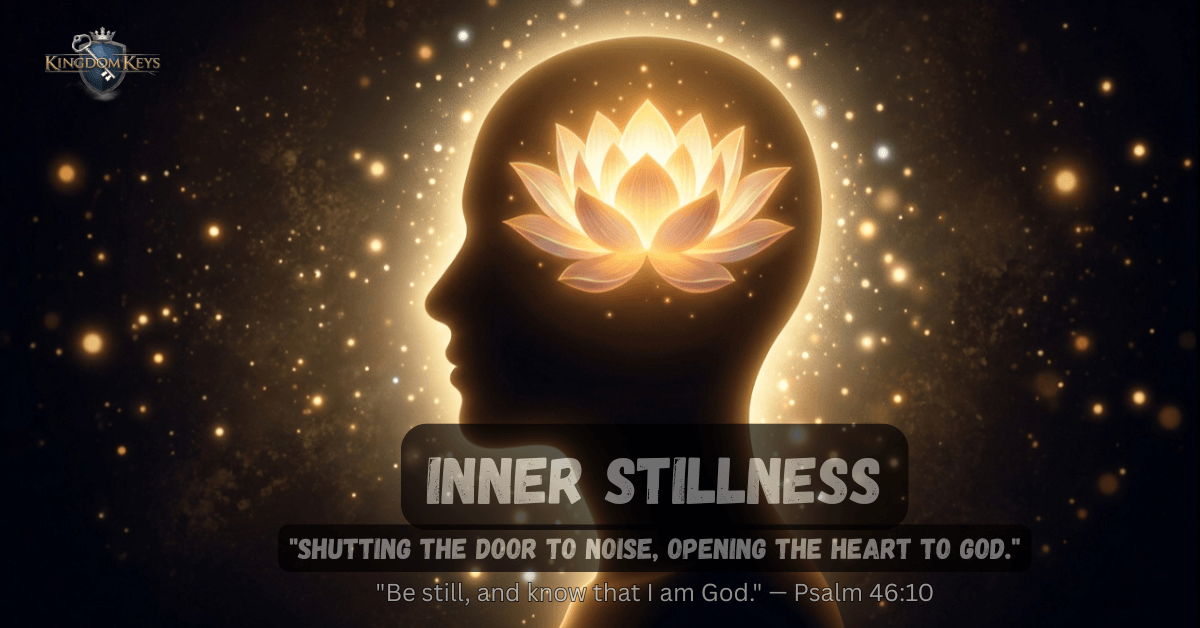
Inner Stillness
Shutting the Door to Noise, Opening the Heart to God.
What Is Meditation
Sacred Attentiveness, Not Emptying the Mind
For many believers, the word meditation can feel unfamiliar, misunderstood, or even concerning.
Yet throughout Scripture, we find repeated invitations to stillness, reflection, attentiveness, and communion with God.
Meditation, as understood within Kingdom Keys, is not about escaping reality, emptying the mind by force, or adopting practices that separate us from God.
Rather, it is the gentle practice of quieting outer distractions and calming the restless activity of the mind so that the heart and spirit may become more receptive to divine presence, wisdom, and truth.
Scripture teaches:
“Be still, and know that I am God.” — Psalm 46:10
Stillness is not emptiness.
Stillness is sacred attentiveness.
It is the intentional turning away from noise, distraction, and inner turbulence in order to become more aware of God's presence.
Jesus Himself instructed:
“But thou, when thou prayest, enter into thy closet, and when thou hast shut thy door, pray to thy Father which is in secret…” — Matthew 6:6
While these words certainly include withdrawing from outward distractions, they also point toward an inward invitation.
To “shut the door” is not merely to enter a room.
It is to close the door to mental chatter.
To quiet anxious thoughts.
To step away from inner noise.
To become present.
To become attentive.
To become available.
Meditation, in this deeper sense, is the practice of entering that secret place within — a posture of stillness, awareness, and quiet communion with God.
You are not disconnecting from God in stillness.
You are becoming more aware of Him.
You are not striving to silence your mind.
You are learning to rest within His presence.
In a world filled with constant noise, stimulation, and mental activity, meditation becomes a sacred return — a quiet homecoming to peace, attentiveness, and divine communion.
The Secret Place Within
An Inward Posture of Stillness
Jesus taught:
“But thou, when thou prayest, enter into thy closet, and when thou hast shut thy door, pray to thy Father which is in secret…” — Matthew 6:6
These words certainly encourage us to withdraw from outward distractions and cultivate private communion with God.
Yet they may also point toward something deeper.
From a Kingdom Keys perspective, “shutting the door” is not only about entering a physical room.
It is also about entering an inward posture of stillness.
It is the intentional closing of the door to:
- External noise
- Mental chatter
- Inner agitation
- Fear and anxious thoughts
- Endless distractions
- The pressure to perform
In this deeper sense, the secret place is not merely a location.
It is a posture of awareness and communion.
It is the quiet place within where the heart becomes attentive and the spirit becomes receptive to God's presence.
This does not mean withdrawing from life.
Nor does it mean forcing the mind into silence.
Rather, it is a gentle invitation to become present.
To become aware.
To become available.
To rest in God's presence without striving.
Just as a seed takes root more easily in fertile soil, truth is often received more deeply when the inner atmosphere has become calm, receptive, and still.
The secret place, then, is not something we visit only occasionally.
It becomes a sacred rhythm — a returning.
A quiet homecoming.
A place where the noise fades, the heart softens, and communion with God becomes more deeply experienced.
To “shut the door” is not merely to leave the world behind. It is to become inwardly available to God.
The Biblical Foundation of Stillness & Meditation
Deeply Woven Into the Spiritual Life
Stillness, reflection, and meditation are not foreign concepts within Scripture.
They are deeply woven into the spiritual life of those who sought clarity, wisdom, and communion with God.
Long before modern interpretations of meditation existed, Scripture encouraged believers to pause, reflect, and quiet the mind in order to remain spiritually aware and aligned.
“Be still, and know that I am God.” — Psalm 46:10
This call to stillness is not merely poetic language.
It is a spiritual invitation — to step away from mental striving, inner noise, and external distractions, and return to a posture
of awareness and trust.
Another foundational instruction appears in the book of Joshua:
“This book of the law shall not depart out of thy mouth; but thou shalt meditate therein day and night…” — Joshua 1:8
Here, meditation is not described as empty thinking, but as intentional reflection and continual alignment with truth.
It is a practice of:
- Remembering truth
- Reflecting on wisdom
- Renewing the mind
- Staying spiritually attentive
Likewise, the renewal of the mind is emphasized in the New Testament:
“Be transformed by the renewing of your mind…” — Romans 12:2
Renewal does not occur in constant mental noise.
It often begins in moments of stillness, reflection, and intentional awareness.
Throughout Scripture, we see a consistent pattern:
God often speaks, guides, and restores not in chaos - but in quietness, stillness, and attentive presence.
How to Practice Meditation
A Gentle, Sacred Return
Meditation within Kingdom Keys is a gentle practice — not a rigid technique or forced exercise.
It is an invitation to slow down, quiet the inner noise, and become more aware of God's presence.
Find a Quiet Space
Choose a place where you can sit without interruption.
Let this space feel peaceful, welcoming, and set apart.
🔊Slow Your Breath
Take several slow, intentional breaths.
With each exhale, release tension and mental noise.
👃Turn Awareness Inward
Gently shift your attention from external distractions to the quiet place within.
Become aware of God's presence — not distant, but near.
Reflect on Truth
You may hold a scripture, a divine attribute, or a simple truth in your awareness.
Let it settle within you — not analyzed, but received.
🌅Rest in Stillness
Do not rush.
Remain in the quiet awareness of God's presence.
Let stillness become the space where communion happens naturally.
Continue in Sacred Stillness
A Quiet Homecoming
Meditation is not a destination — it is a returning.
A quiet homecoming to peace, attentiveness, and divine communion.
As you continue your journey, allow stillness to become a rhythm — not an obligation, but a sacred gift you give yourself.
In stillness, God is not distant. In quietness, truth is not absent. In awareness, communion is not far away.
Explore additional Prayer Room resources to deepen your journey:
🕎️Guided Prayer & Meditation
Experience guided moments of prayer, reflection, and spiritual stillness designed to support alignment and inner peace.
🕍️A Preparation Prayer
Align your heart, still your soul, and receive with readiness through this sacred prayer of preparation.
🕎️Quieting the Mind Before Study
Prepare your heart and mind through stillness, focus, and intentional spiritual quietness before engaging scripture or prayer.