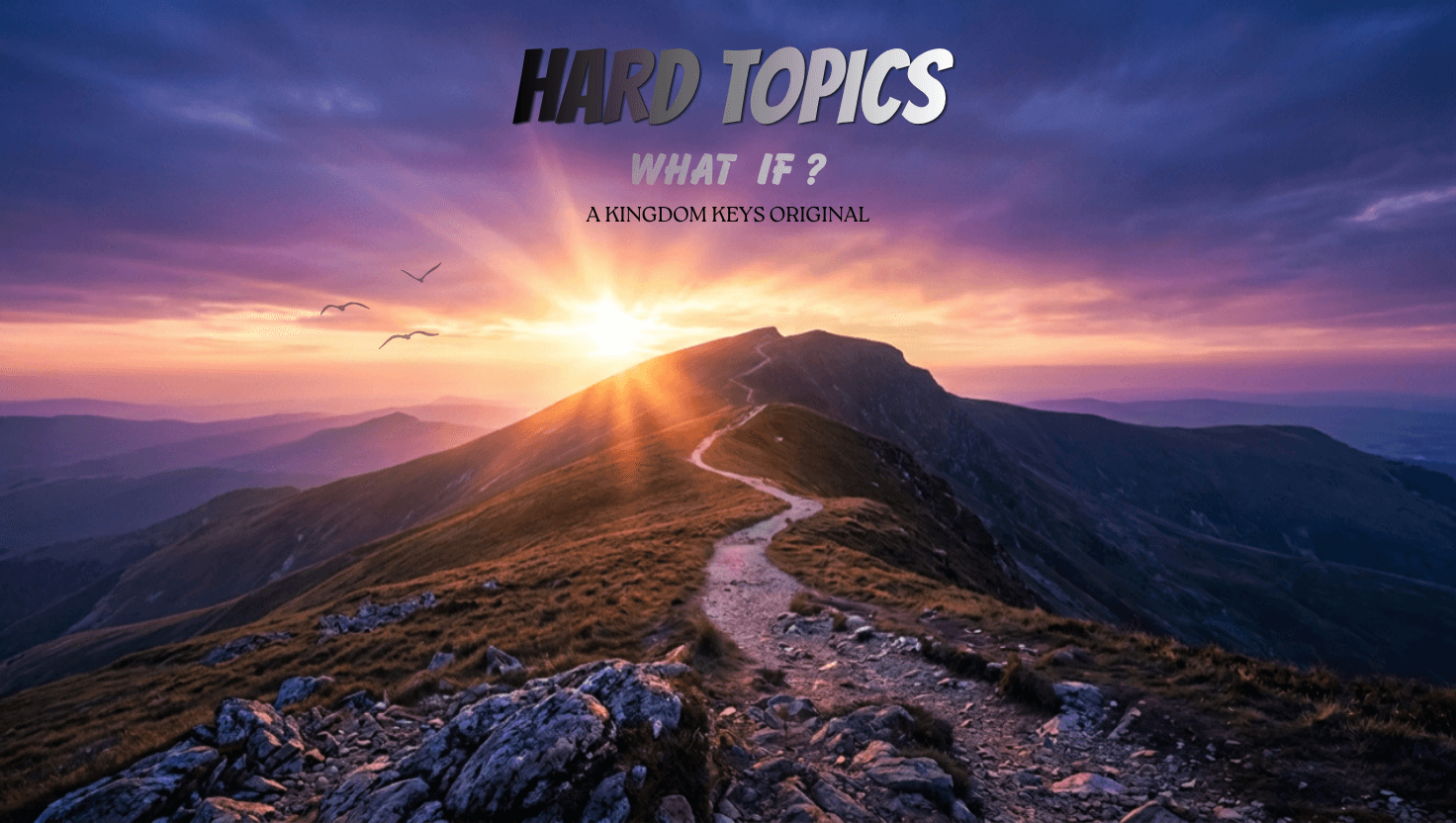
◐ HARD TOPICS
Some questions deserve more than a quick answer.
📖And God called the light Day, and the darkness he called Night. And the evening and the morning were the first day. — Genesis 1:5 KJV
What If There Is More to See?
There are questions we answer quickly because the way forward seems clear.
And then there are questions that ask something more of us.
They invite us beyond what is familiar—beyond the answers we have inherited, the conclusions we have reached, and sometimes even beyond what we are presently able to see.
Hard Topics was created for those questions.
Not to tell you what to think. Not to convince you to abandon what you believe. And not to replace one certainty with another. Hard Topics is an invitation to look again.
To consider another perspective.
To examine what may have been overlooked.
To listen where we might normally defend.
To remain curious when an easy answer would be more comfortable.
Sometimes greater understanding begins when we become willing to loosen our grip on what we think we already know —not to throw it away, but to make room for the possibility that there may be more to see.
Genesis describes the first day in an intriguing order: “…there was evening, and there was morning…”
Evening is where familiar light begins to fade. The landscape has not disappeared. We simply cannot see it as clearly as before. And yet, beyond the uncertainty of night, morning comes—bringing light again and revealing what could not previously be seen.
Perhaps discovery sometimes works the same way.
We begin with what we know. We encounter something that challenges the boundaries of that understanding. We become willing to enter what we do not yet fully understand. And sometimes, on the other side, we discover a larger horizon.
Hard Topics exists for that journey.
There may not always be a simple answer waiting at the end. There may not even be agreement.
But there may be greater understanding. Greater compassion. Greater perspective.
And perhaps enough new light to ask a different question: What if there is more to see?
◐ THE EDGE OF KNOWING
Where certainty ends, exploration can begin.
There is a certain comfort in what we already know.
Our beliefs, experiences, traditions, education, relationships, and understanding of Scripture help us make sense of the world around us. They give us language for what we experience and help us determine what feels true, familiar, safe, or certain.
There is nothing wrong with having convictions. But sometimes growth begins when we encounter something that does not fit neatly inside what we already understand.
A question we cannot easily answer. A perspective we had never considered. An experience that challenges an assumption. A Scripture that seems deeper than the explanation we were given. A person's story that makes judgment more difficult than it once seemed.
Or perhaps simply a quiet thought: What if there is more here than I can presently see?
That moment does not require us to abandon what we believe. It simply invites us to recognize the possibility that what we presently see may be real without necessarily being complete.
Standing at the edge of knowing requires a different kind of courage—the willingness to remain curious when certainty would be easier. To listen before defending. To examine before dismissing. To wonder before deciding.
And sometimes, to walk a little farther even when we cannot yet see where the path leads. Hard Topics begins there.
Not with the assumption that everything we know is wrong. But with the humility to consider that there may still be more to discover.
◈ FROM WHERE YOU STAND
Sometimes the picture changes when we change our point of view.
Two people can look at the same situation and see something entirely different.
Not necessarily because one is sincere and the other dishonest. Not necessarily because one is wise and the other foolish. Sometimes they are simply standing in different places.
Each of us sees life through a collection of experiences, beliefs, relationships, traditions, teachings, disappointments, discoveries, cultures, fears, hopes, and questions that have helped shape the way we understand the world. These become the lenses through which we see. And because those lenses feel natural to us, we may not always realize they are there.
What appears obvious from where we stand may look very different from somewhere else.
A belief that seems unquestionable may carry an entirely different meaning when viewed through another person's experience. A decision that appears impossible to understand from the outside may become far more complex once we know the story behind it. Even a familiar passage of Scripture can reveal dimensions we never noticed when we encounter it from another season of life, another question, or another depth of understanding.
This does not mean that every perspective is equally accurate. And it does not mean that truth changes according to where we stand. It simply means that our view of truth may be affected by the limits of our present vantage point.
Sometimes seeing more requires movement.
Not necessarily changing sides. Not abandoning conviction. Simply becoming willing, for a moment, to stand somewhere else and look again.
Because when we do, something remarkable can happen: What once appeared simple becomes more complete. What once appeared separate begins to connect. What once invited judgment may begin to invite understanding.
And sometimes we return to exactly where we started— but we return seeing differently.
Perhaps the question is not always: “Which side am I on?”
Perhaps sometimes the better question is: “What can I see from here that I couldn't see from there?”
🌅BETWEEN EVENING AND MORNING
Sometimes new light is discovered only after we become willing to leave the familiar light behind.
There is something intriguing about the way Genesis describes the first day: “…there was evening, and there was morning—the first day.”
Evening before morning. It is easy to pass over those words without noticing their order. But there is something beautiful hidden within that progression.
Evening is not complete darkness. It is the place where the light we have been using begins to fade. The landscape is still there. Nothing has necessarily changed around us. Yet what once seemed obvious becomes less distinct. Familiar shapes become harder to define. We can no longer rely entirely upon what we could see before.
And eventually, night comes.
There are moments in life when understanding can feel much the same. We encounter a question that our familiar answers cannot quite resolve.
Something we experience does not fit comfortably within what we have always believed. We hear another person's story and discover that the judgment that once seemed simple has become complicated. We revisit a Scripture we thought we understood and suddenly notice something we had never seen. The temptation in those moments can be to hurry back toward certainty.
But what if uncertainty is not always something to fear? What if sometimes it is simply evening? A temporary place between the light we have known and light we have not yet encountered.
There are things we can discover only when we become willing to say: “I don't know.” Not as a confession of failure. But as an opening. A willingness to listen. To question. To explore. To remain present long enough for something else to become visible.
And then comes morning.
Not necessarily with every mystery resolved. Not necessarily with the answer we expected.
Sometimes morning brings a new understanding. Sometimes it brings a larger question. Sometimes it allows us to understand another person. Sometimes it reveals that two things we once thought were completely separate were connected all along.
And sometimes the only thing morning changes is the person who walked through the night. Perhaps that is why the journey matters.
We are not entering difficult questions because darkness is the destination. We enter because we believe there may always be more light to discover.
The evening and the morning.
Not the end of knowing. The beginning of another day.
🔎LET'S LOOK
Not everything difficult needs to become a debate.
When we encounter something that challenges what we believe, it can be tempting to immediately decide what side we are on.
Agree or disagree. Right or wrong. For or against. Defend or reject.
But sometimes there is another possibility. We can look.
We can become curious before becoming certain. We can ask where an idea came from. We can examine what Scripture actually says—and what we may have assumed it says. We can consider history, context, evidence, experience, and perspectives different from our own. We can listen to someone's story before reducing their life to a decision, a belief, a label, or a moment. We can recognize the difference between understanding something and agreeing with it. And perhaps most importantly, we can allow questions to remain questions long enough to discover what they may have come to teach us.
This is the heart of Hard Topics. There is no requirement that everyone who enters arrive at the same conclusion.
You may discover that what you have always believed becomes even stronger after examining it. You may discover that part of what you believed needs expanding. You may recognize something you had never considered. You may develop compassion for someone whose choices you still do not understand or agree with.
Or you may simply leave saying: “I don't know yet.” And here, that is allowed.
Because exploration is not about exchanging certainty for confusion. It is about becoming willing to see the whole field before deciding what the landscape contains.
So when we encounter the difficult question... When something makes us uncomfortable... When familiar answers no longer seem sufficient... When two seemingly opposing truths appear before us...
We do not have to immediately fight. We do not have to immediately defend. We do not have to immediately decide.
Sometimes we can simply say: Let's look.
And perhaps, somewhere in the looking, something that was hidden begins to come into view.
What if understanding begins before agreement?
♡BEHIND EVERY TOPIC, THERE IS A STORY
Understanding changes when we remember there are people behind the questions.
It is easier to judge an idea than to understand a life.
From a distance, human experiences can appear surprisingly simple. We see a decision. A behavior. A belief. A failure. A disagreement. A label. And from what we can see, we form a conclusion.
But a human life is rarely contained within the part that is visible. Behind what we see may be years of experiences we know nothing about.
Questions never spoken. Losses never explained. Beliefs inherited before they could be examined.
Fears quietly carried. Choices made with information we did not have. Wounds hidden beneath behavior.
And sometimes extraordinary courage that no one else ever noticed.
This does not mean that understanding someone's story requires us to agree with every decision they have made. It means that a person is always greater than the fragment of their life we happen to be looking at.
That matters here. Because Hard Topics may sometimes take us into places where disagreement is strong, emotions are real, convictions run deep, and simple answers are tempting.
In those moments, we want to remember something easily lost: We are not merely examining issues. We are encountering humanity.
Sometimes hearing the story behind a belief changes the way we understand the belief. Sometimes understanding the pain behind a decision changes the way we see the person who made it.
Sometimes seeing through another person's eyes reveals something about our own. And sometimes two people can continue to disagree while discovering that neither one has to become the enemy.
Perhaps greater understanding does not always require us to change our convictions. Sometimes it simply asks us to enlarge the space in which we hold them.
A space large enough for truth. Large enough for questions. Large enough for another perspective. And large enough for one another.
Because beneath the arguments, categories, doctrines, statistics, and labels... there is always a human story worth seeing.
✦ THE POWER OF “WHAT IF?”
A question does not always ask you to change your mind. Sometimes it simply asks you to open it.
There is freedom in two very small words: What if?
They do not demand agreement. They do not insist that what you believe is wrong. They do not require you to abandon your convictions or replace one belief with another. They simply open a door.
What if there is another perspective?
What if something we dismissed deserves another look?
What if two ideas that appear completely opposed are carrying different pieces of a larger picture?
What if the question itself needs to be reconsidered?
What if there is something here we have not yet learned how to see?
A genuine What If? does not hide an answer inside the question. It creates room for discovery.
That distinction matters.
Hard Topics is not interested in using questions to quietly lead you toward a conclusion we have already chosen.
Sometimes the exploration may strengthen what you already believe. Sometimes it may expand it. Sometimes it may challenge an assumption. Sometimes it may reveal that the subject is far more complex than either side has acknowledged.
And sometimes... we may simply discover that we do not know enough yet.
There is wisdom in being able to stand there. To wonder without immediately needing resolution. To encounter another possibility without feeling threatened by its existence. To hold a question long enough for something deeper to emerge.
Perhaps we have sometimes treated certainty as the evidence of strong faith, when there may also be a kind of faith required to say: “There is more here than I understand.”
Because wonder begins where the need to know everything ends.
And when we become willing to wonder, possibilities begin appearing where we once saw only boundaries.
The mind becomes less occupied with defending what it already knows and more available to recognize what it has never seen.
That is why What If? matters here.
It is not an invitation to believe everything. It is an invitation to be willing to look.
To examine. To question. To listen. To discern. To wonder.
And perhaps to discover that truth is larger than the piece of it we were previously able to hold.
So throughout Hard Topics, you may encounter these two words again and again. Not because we already know where they will lead. But because sometimes the beginning of a new morning is simply the courage to ask: What If?
✦ ENTER THE CONVERSATION
Some questions are better explored than answered.
Hard Topics may begin with a question. A story. A passage of Scripture. A personal experience. A belief we have rarely examined. A subject people have learned not to discuss. Or something that simply does not fit comfortably within the answers we already have.
Wherever the journey begins, we are willing to follow the question deeper.
We may explore Scripture and the different ways it has been understood.
We may look at history and discover how certain ideas developed.
We may consider research, evidence, culture, psychology, philosophy, or the experiences of people who have actually lived what others only discuss.
We may hear perspectives that agree with one another. And perspectives that do not.
Sometimes we may encounter a story before we ever encounter the discussion.
A film may allow us to step temporarily into another person's world—to experience the tension, complexity, choices, consequences, hopes, fears, and questions from somewhere other than where we normally stand.
Then, when the story ends, the exploration does not necessarily end with it. We can GO DEEPER.
Into the conversation behind the story. Into the Scriptures that illuminate it. Into the questions it raises.
Into what we know. What we believe. What people have experienced.
What we still do not know. And what might be possible.
But Hard Topics is not a courtroom. There is no requirement that every exploration end with a verdict.
Sometimes we may reach greater clarity. Sometimes we may uncover another layer.
Sometimes two perspectives that appeared incompatible may reveal unexpected points of connection. Sometimes we may discover that something we were certain about deserves another look.
And sometimes the most truthful conclusion available to us may simply be: We don't know yet.
That is not where exploration fails. Sometimes that is where genuine exploration finally begins.
Because Hard Topics is not about collecting answers. It is about learning how to remain present with meaningful questions long enough to see what they might reveal.
So bring your curiosity. Bring your questions. Bring your convictions. Bring your experiences. Even bring your disagreement.
You do not have to leave any of them at the door. We ask only that you bring one thing with them:
A willingness to look.
♡HOW WE ENTER
Curiosity opens the door. Humility helps us walk through it together.
Hard Topics may take us into places where convictions run deep.
There may be moments when something challenges us. When we strongly disagree.
When a perspective feels unfamiliar. When a question touches something deeply personal.
That is why how we enter matters just as much as what we explore.
We can be curious without believing everything we encounter.
We can hold strong convictions without assuming there is nothing left to learn.
We can question an idea without attacking the person who holds it.
We can examine Scripture without using it as a weapon against one another.
We can consider evidence while recognizing the difference between what is known, what is interpreted, and what remains uncertain.
We can listen to someone's experience without assuming that one experience explains every experience.
We can disagree without reducing one another to labels.
And we can change our understanding without being ashamed that we once saw things differently.
Hard Topics does not ask us to leave discernment behind.
Quite the opposite. It asks us to bring discernment together with something equally important: humility.
The humility to recognize that none of us sees everything from where we presently stand. The humility to listen before assuming.
The humility to say, “I may need to think about that.”
The humility to say, “I don't know.”
And sometimes even the humility to say: “I was wrong.”
But there is something else we carry into every exploration. Human dignity.
Behind every position is a person. Behind many difficult questions is someone's actual life.
Someone's family. Someone's loss. Someone's faith. Someone's fear. Someone's hope. Someone's story.
No question is so important that we must forget the humanity of the people connected to it.
We may examine ideas rigorously. We may challenge assumptions. We may encounter uncomfortable truths. We may disagree deeply.
But we do not have to diminish one another in order to do any of those things.
Perhaps the strongest conversations are not the ones where someone wins. Perhaps they are the ones where everyone leaves seeing a little more.
So when we enter Hard Topics, we enter with our questions. Our convictions. Our experiences. Our uncertainties. Our discernment. And our humanity.
**We come not merely prepared to speak— but willing to listen, look, and discover together.**
🌅WHEN MORNING COMES
The journey does not always give us the answer we expected. Sometimes it gives us new eyes.
Every exploration begins somewhere.
We begin with what we know. What we have experienced. What we have been taught. What we believe. What we can presently see.
And then something invites us farther.
A question. A contradiction. Another person's story. An unexpected discovery. A quiet sense that perhaps there is more.
The familiar light begins to change. Evening comes.
And for a while, we may find ourselves standing somewhere between what we once understood and what we have not yet learned to see.
That space can feel uncertain. But it can also be sacred. Because we do not have to rush through it.
We do not have to manufacture an answer simply because we are uncomfortable without one.
We can listen. We can examine. We can wonder.
We can allow what seemed separate to come closer together. And we can remain there long enough for something new to emerge.
Then, sometimes quietly, morning comes.
Perhaps nothing around us has changed. Perhaps the question is still there. Perhaps people still disagree. Perhaps there are mysteries we still cannot explain.
But something within our seeing has changed.
The horizon has become larger. The person we once judged has become more human.
The belief we once defended has become deeper—or perhaps more spacious. The question we once feared has become something we are willing to explore. And what appeared to be the end of certainty becomes the beginning of another discovery.
This is the journey of Hard Topics.
We are not searching for darkness. We are not abandoning light.
We are simply willing to walk beyond the edge of what we presently see, trusting that there may still be more to discover.
Because morning does not necessarily mean we finally see everything.
Sometimes it simply means: We can see farther than we could before. And perhaps that is enough for another day.
WHAT IF THERE IS MORE TO SEE?
You don't have to know where the question will lead. You only have to be willing to look.
An Original Kingdom Keys Experience